
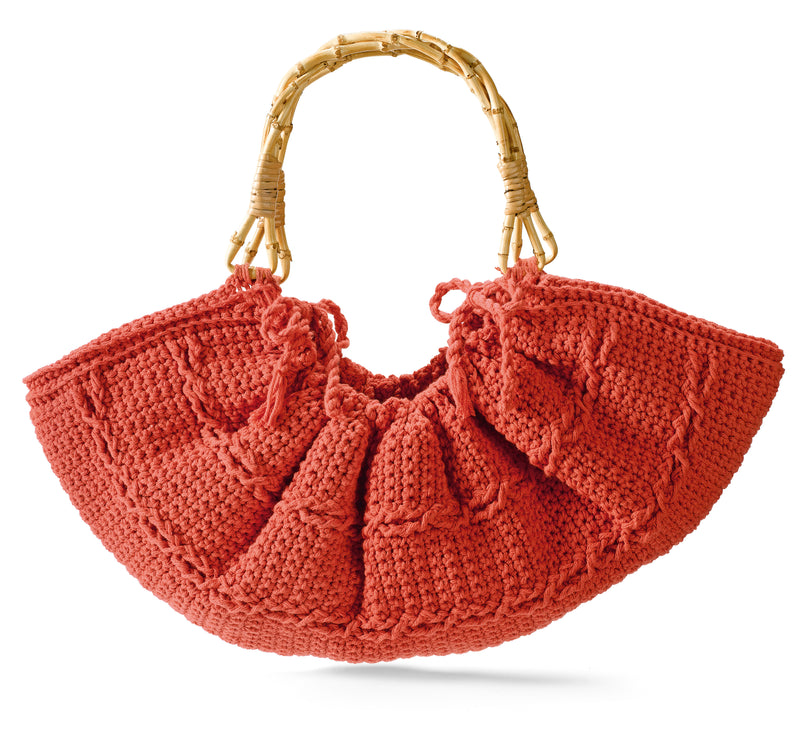
From the book KNIT OR CROCHET: HAVE IT YOUR WAY by Margaret Hubert, courtesy of Creative Publishing International. For the knitted version, click here.
To change colors, simply select color name from the drop-down above or else click the swatch you want to change and then click a color below
Cotton-Ease® (new)
Sand
Almond
Snow
Blossom
Lake
Berry
Cherry
Taupe
Seaspray
Hazelnut
Cactus
Terracotta
Plum
Turquoise
Stone
Charcoal
Maize
Golden Glow
Violet
Lime
Azalea
*CottonEase
(Article #700) is a versatile, soft cotton blend worsted weight yarn 50% Cotton/50% Acrylic. It comes
in 3.5 oz/100g (207 yd/188m) balls
You can also buy materials separately
MATERIALS To
change colors, click the drop-down list or swatches above
QUANTITY
PRICE
ALT QTY
Additional Materials Pair of handles, 7 7/8 in. (20 cm) wide at base
1/2 yd. (0.5 m) fleece interfacing
1/2 yd. (0.5 m) lining fabric
Sewing needle and thread
Safety pin
Special Discount! Buy all items above now and save 15%!
Wooden Handle Tote
Lion Brand® Cotton-Ease® (new)
GAUGE:
13 1/2 sts = 4 in. (10 cm) BE SURE TO CHECK YOUR GAUGE. When you match the gauge in a pattern, your project will be the size specified in the pattern and the materials specified in the pattern will be sufficient. If it takes you fewer stitches and rows to make a 4 in. [10 cm] square, try using a smaller size hook or needles; if more stitches and rows, try a larger size hook or needles.
STITCH EXPLANATION:
Front post double crochet (FPdc): yo, insert hook from front to back to front again around the post of next st, yo, draw yarn through st, (yo, draw yarn through 2 loops on hook) twice.
NOTES:
1. The beg ch 1 counts as a sc and will be referred to as sc throughout.
Detachable
Counter: Click and drag to the part of the pattern you're working. Your
counter is automatically saved and will be here when you next use the
pattern.Project
Counter: Use this to track your work. Your counter is automatically
saved and will be here when you next use the pattern.
TOTE Ch 59.
Foundation row: Working in the BL of each ch, starting in 2nd ch from hook, work 1 sc in each ch across row, turn—58 sc.
Row 1 (eyelet row) (RS): Ch 1 (counts as a sc now and throughout), sk first sc, working in the BL only, sc in next sc, ch 1, sk next sc, 1 sc in each sc across to within last
3 sc, ch 1, sk next sc, 1 sc in next sc, sc in top of tch, turn.
Row 2: Working in BL only, ch 1,
sk first sc, 1 sc in next sc, 1 sc in next ch-1 space, 1 sc in each sc across to next ch-1 space, 1 sc in next ch-1 space, 1 sc in each of the last 2 sts, turn.
Rows 3–4: Rep Rows 1–2.
Row 5 (begin cable pat): Ch 1, sk first sc, working in BL only, 1 sc in next sc, ch 1, sk next sc, 1 sc in next sc, *working in both loops of sts, 1 sc in each of the next 6 sc, FPdc around the post of next st, 1 sc next sc, FPdc around the post of next st; rep from * once, 1 sc in each of next 14 sc, **FPdc around the post of next st, sc in next sc, FPdc around the post of next st, 1 sc in each of next 6; rep from ** once, working in BL only, 1 sc in next sc, ch 1, sk next sc, 1 sc in each of last 2 sts, turn.
Row 6: Ch 1, sk first sc, working in BL only, 1 sc in next sc, 1 sc in next ch-1 sp, 1 sc in next sc, working in both loops of sts, 1 sc in each st across to within last 4 sts, working in BL only, 1 sc in next sc, 1 sc in next ch-1 sp, 1 sc in each of last 2 sts, turn.
Row 7: Ch 1, sk first sc, working in BL only, 1 sc in next sc, ch 1, sk next sc, 1 sc in next sc, *working in both loops of sts, 1 sc in each of next 6 sc, FPdc around the post of next FPdc, 1 sc in next sc, FPdc around the post of next FPdc; rep from * once, 1 sc in each of next
14 sc, **FPdc around the post of next FPdc, 1 sc in next sc, FPdc around the post of next FPdc, 1 sc in each of the next 6 sc; rep from ** once, working in BL only, 1 sc in next sc, ch 1, sk next sc, 1 sc in each of last 2 sts, turn.
Row 8: Rep Row 6.
Row 9: Ch 1, sk first sc, working in BL only, 1 sc in next sc, ch 1, sk next sc, 1 sc in next sc, *working in both loops of sts, sc in each of next 6 sc, sk next FPdc and next sc, FPdc around the post of next FPdc, 1 sc in skipped sc, FPdc around the post of last skipped FPdc (cable twist made) rep from * once, 1 sc in each of next 14 sc, **sk over next FPdc and next sc, FPdc around the post of next FPdc, 1 sc in skipped sc, FPdc around the post of last skipped FPdc, 1 sc in each of next 6 sc; rep from ** once, working in BL only, 1 sc in next sc, ch 1, sk next sc, 1 sc in each of last 2 sts, turn.
Rows 10–11: Rep Rows 6–7.
Rep Rows 6–11 until piece measures 25" (63.5 cm) from beg, then rep Rows 2–3 twice. End off.
Lining Line bag while flat before assembly.
Cut the fleece interfacing so it does not cover the eyelet edges. Hand-sew in place. Cut the lining fabric 1” (2.5 cm) larger than the fleece. Fold under all sides ½” (1.3 cm). Sew the lining to the bag, over the interfacing.
Finishing Twisted Cord (Make 2) Cut two strands of yarn, each 4½ yd. (4 m), hold together, fold in half. Anchor the folded end, twist these strands until they become very tightly wound. Being sure not to release ends, bring cut ends and folded ends together, hold up and allow to twist into a cord. Tie the loose side tightly, about 1½" (4 cm) from end, to form a small tassel and to anchor cord. Make a second cord.
Using a large safety pin, weave the finished cords in and out of the eyelet holes at edges of bag; draw up tightly.
Using leftover purse yarn and a tapestry needle, sew the handles
to the top corners of the bag.
Tie opposite cord ends together in bows at the base of the handles.
ABBREVIATIONS / REFERENCES Click for explanation and illustration
Wooden Handle Tote Reviewed by Phoebe on 2009-05-21
this was a great pattern. But it most deffinantly needs to be changed to intermediate! this is not an easy pattern (at least not until you get the hang of it). I did mine differently than the pattern says. I used different handles, and did not use the fleece interfacing, I also sl st my sides together with the handles.