Worsted Weight Yarn Defined: Your Complete Guide
Worsted weight yarn is defined as a Category 4 medium-weight yarn in the Craft Yarn Council’s standardized numbering system, sitting thicker than DK and lighter than bulky. It is the most widely stocked yarn weight at craft stores and the default choice in thousands of beginner and intermediate patterns. The term “worsted” carries two distinct meanings in the fiber world: one describes yarn thickness, the other describes a spinning method. Knowing the difference changes how you shop, swatch, and substitute. This guide covers both, plus everything you need to pick the right yarn for your next project.
What is worsted weight yarn? Official classification explained
Worsted weight yarn occupies the middle of the Craft Yarn Council’s seven-category weight system, labeled Category 4 Medium. That placement is not arbitrary. Category 4 is the sweet spot between the fine detail of lighter weights and the fast-working bulk of heavier ones, which is exactly why it dominates retail shelves and pattern libraries.
The standard characteristics of Category 4 worsted weight yarn are:
Wraps per inch (WPI): approximately 9 to 12 wraps per inch
Knitting gauge: 16 to 20 stitches per 4 inches on recommended needles
Recommended knitting needles: US size 7 to 9 (4.5 to 5.5 mm)
Recommended crochet hooks: US size I/9 to K/10.5 (5.5 to 6.5 mm)
Typical yardage per 100g: 200 to 240 yards
That gauge range of 16 to 20 stitches per 4 inches means your fabric will have clear stitch definition without feeling stiff. For crocheters, that translates to a fabric with good drape and structure at the same time, which makes worsted weight ideal for garments, accessories, and home decor alike.
Pro Tip: Always check the specific gauge printed on your yarn label rather than relying on the category number alone. Two Category 4 yarns from different brands can knit up at noticeably different stitch counts depending on fiber content and twist.
Here is how worsted weight compares to the weights immediately above and below it:
| Weight | Category | WPI | Knitting gauge (per 4 in.) | Needle size (US) |
|---|---|---|---|---|
| DK | 3 (Light) | 12–15 | 21–24 stitches | 5–7 |
| Worsted | 4 (Medium) | 9–12 | 16–20 stitches | 7–9 |
| Bulky | 5 (Bulky) | 6–8 | 12–15 stitches | 9–11 |
The numbers make the differences concrete. Moving from DK to worsted removes roughly 3 to 4 stitches per 4 inches of width, which means a noticeably thicker, warmer fabric. Moving from worsted to bulky adds even more thickness and dramatically reduces stitch count, which speeds up projects but limits fine detail.
Worsted weight vs. worsted-spun: why the name confuses crafters
The word “worsted” appears in two completely different contexts in yarn, and conflating the two is one of the most common mistakes new knitters and crocheters make.
Worsted weight refers strictly to yarn thickness. It is a classification in the Craft Yarn Council system. Any fiber, any brand, any spinning method can produce a worsted weight yarn as long as it falls within the Category 4 gauge and WPI range.
Worsted-spun refers to a fiber processing method. In worsted spinning, fibers are combed parallel before being twisted into yarn. The result is a smooth, dense, durable yarn with excellent stitch definition. It contrasts with woolen-spun yarn, where fibers are less processed, producing a loftier, fuzzier result.
Here is the practical breakdown every crafter needs:
A yarn can be worsted weight but not worsted-spun. Lion Brand Vanna’s Choice is a Category 4 acrylic. Acrylic is not spun in the traditional worsted method, yet it is absolutely a worsted weight yarn.
A yarn can be worsted-spun but not worsted weight. A finely spun worsted-spun wool could fall into the DK or fingering category.
A yarn can be both. Many wool yarns, including Lion Brand Fishermen’s Wool, are worsted-spun and fall in the Category 4 range.
For pattern compatibility, weight is what matters. When a pattern calls for worsted weight yarn, it is specifying thickness and gauge, not spinning method. Choosing a worsted-spun yarn in a different weight will break your gauge and distort your finished piece.
Pro Tip: When a pattern lists “worsted weight” without further detail, treat it as a gauge instruction. Match the stitch count on the label to the pattern’s gauge requirement, and you will be on solid ground regardless of fiber or spinning method.
Worsted weight vs. aran vs. bulky: which one do you actually need?
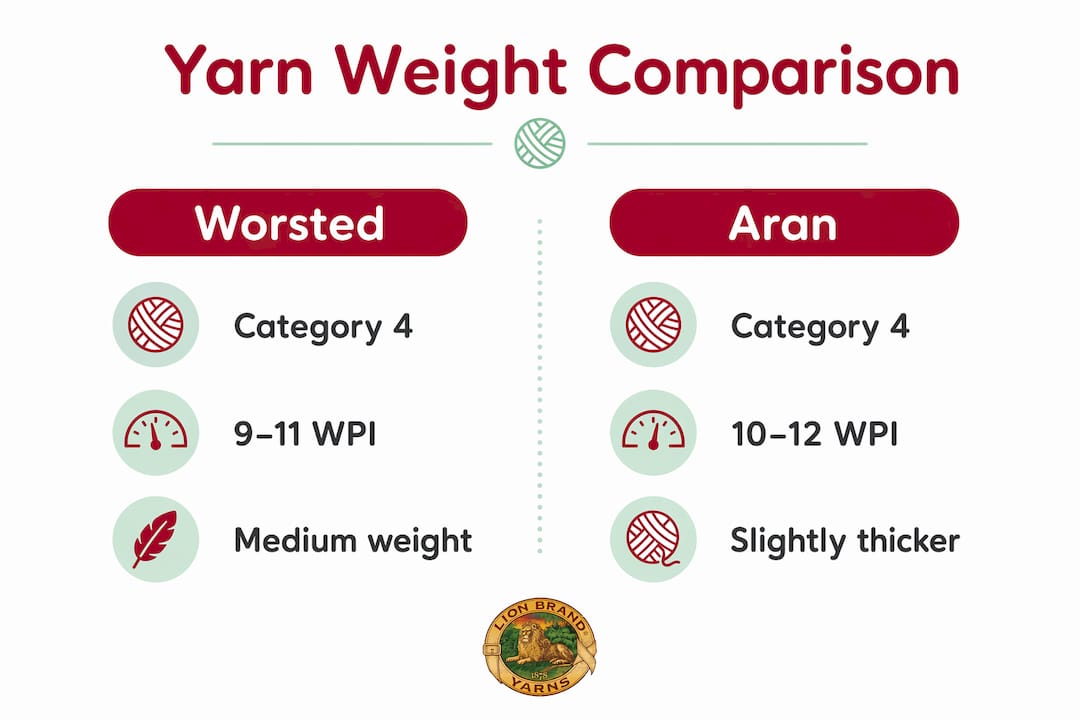
Aran yarn sits inside Category 4 alongside worsted, which surprises many crafters. The Craft Yarn Council groups them together, but they are not identical. Aran yarn runs slightly thicker than standard worsted, with a WPI of 10 to 12 and a yardage of roughly 180 to 200 yards per 100g compared to worsted’s 200 to 240 yards.
That difference matters in practice. Aran yarn produces a denser, heavier fabric at the same needle size, which is why it is the traditional choice for Irish cable sweaters and structured outerwear. Worsted produces a slightly lighter, more drapey result, making it better suited for fitted garments, shawls, and accessories where you want movement.
| Yarn type | Category | WPI | Yardage per 100g | Best for |
|---|---|---|---|---|
| Worsted | 4 (Medium) | 9–10 | 200–240 yards | Garments, accessories, blankets |
| Aran | 4 (Medium) | 10–12 | 180–200 yards | Cables, outerwear, structured pieces |
| Bulky | 5 (Bulky) | 6–8 | 100–140 yards | Chunky blankets, scarves, quick gifts |
Bulky yarn (Category 5) is a different animal entirely. It works up fast on US size 9 to 11 needles and produces thick, cozy fabric with minimal stitch detail. Lion Brand Hue + Me is a classic example of a bulky yarn. It is not a substitute for worsted in a fitted sweater pattern, but it is unbeatable for a weekend blanket or a chunky rib scarf.
When substituting aran for worsted or vice versa, expect slight gauge shifts that can affect fit and fabric weight. The fix is straightforward: swatch with the actual yarn you plan to use, then adjust needle size up or down by half a size until your stitch count matches the pattern.
Pro Tip: If you substitute aran for worsted in a garment pattern, go up one needle size and re-swatch. The extra thickness of aran yarn often requires a larger needle to hit the same stitch count, preserving the pattern’s intended fit.
How to identify and select worsted weight yarn for your projects
Reading a yarn label is the fastest way to confirm weight. The Craft Yarn Council symbol, a skein icon with the number 4 inside, appears on most commercially sold yarns in the United States. Look for it on the front or back of the label alongside the recommended needle size and gauge.
For unlabeled or mystery yarn, measuring wraps per inch is the most reliable identification method. Here is how to do it:
Wrap your yarn snugly but not tightly around a ruler or pencil for exactly one inch.
Count the number of wraps. Do not overlap them and do not leave gaps.
Repeat two or three times and average the results for accuracy.
Compare your count to the standard ranges: 9 to 12 WPI confirms worsted weight.
Consistent snugness while wrapping is the most common variable that throws off WPI results. Too loose and you will undercount, pushing the yarn into a heavier category. Too tight and you will overcount, making it appear lighter than it is. Averaging multiple measurements removes most of that error.
After confirming weight by WPI or label, swatching remains the most reliable method to verify a yarn’s suitability for a specific pattern. Cast on at least 20 stitches, work 4 inches in the pattern stitch, and measure your stitch count against the pattern’s gauge. If you have too many stitches per 4 inches, go up a needle size. Too few, go down.
Worsted weight yarn excels across a wide range of project types:
Scarves and cowls: The Statement Scarf pattern is a perfect example of worsted weight showing off clean stitch definition.
Sweaters and cardigans: Worsted’s gauge range gives garments structure without excessive weight.
Shawls: The Coast to Coast Wrap pattern demonstrates how worsted weight creates drape and texture in one piece.
Hats and mittens: Fast to knit, warm to wear, and forgiving for beginners.
Blankets: Worsted weight blankets take longer than bulky but produce a finer, more detailed fabric.
Lion Brand Wool-Ease is one of the most recognized worsted weight yarns in the United States, combining wool and acrylic for warmth, durability, and machine-washability. Lion Brand Heartland and Vanna’s Choice are two more Category 4 options that cover a wide range of project types and fiber preferences.
Key takeaways
Worsted weight yarn is a Category 4 medium-weight yarn defined by a gauge of 16 to 20 stitches per 4 inches, a WPI of 9 to 12, and recommended needle sizes of US 7 to 9.
| Point | Details |
|---|---|
| Official classification | Worsted weight is Category 4 in the Craft Yarn Council system, between DK and bulky. |
| Gauge and needle range | Expect 16 to 20 stitches per 4 inches on US size 7 to 9 needles. |
| Two meanings of “worsted” | Worsted weight is a thickness category; worsted-spun is a fiber processing method. They are not the same. |
| Aran is not identical to worsted | Aran sits in Category 4 but runs slightly thicker, with less yardage per 100g and a denser fabric. |
| Always swatch | WPI confirms weight category; swatching confirms gauge and suitability for your specific pattern. |
Start your next worsted weight project with Lion Brand
Ready to put this knowledge to work? Lion Brand carries an extensive selection of Category 4 yarns across every fiber type, from the classic Wool-Ease to the ultra-soft Feels Like Butta and the colorful Mandala Ombre. Each yarn page lists gauge, recommended needle size, and suggested projects so you can match yarn to pattern with confidence.
FAQ
What is worsted weight yarn?
Worsted weight yarn is a Category 4 medium-weight yarn in the Craft Yarn Council system, with a typical knitting gauge of 16 to 20 stitches per 4 inches and recommended needle sizes of US 7 to 9. It sits between DK (Category 3) and bulky (Category 5) in thickness.
What is the difference between worsted weight and worsted-spun yarn?
Worsted weight describes yarn thickness and gauge classification. Worsted-spun describes a fiber processing method where fibers are combed parallel before spinning. A yarn can be one, both, or neither.
How does worsted weight differ from aran yarn?
Both are Category 4, but aran yarn is slightly thicker, with a WPI of 10 to 12 and roughly 180 to 200 yards per 100g compared to worsted’s 200 to 240 yards. Aran produces a denser fabric and is better suited for cables and structured outerwear.
How do I identify worsted weight yarn without a label?
Wrap the yarn snugly around a ruler for one inch and count the wraps. A count of 9 to 12 wraps per inch confirms worsted weight. Average two or three measurements for the most accurate result.
Can I substitute aran yarn for worsted weight in a pattern?
Yes, but you should swatch first and adjust your needle size. Aran’s extra thickness often requires going up half a needle size to match the worsted gauge specified in the pattern.