7 Free Crochet Cardigan Patterns Beginners Can Finish in a Weekend
Start with an open-front or rectangle-panel cardigan. Most free crochet cardigan patterns built on this shape use worsted-weight yarn, a big hook, and three basic stitches, so a confident beginner can finish one in a weekend. Try the Candy Fuzz Jacket for a quick project, browse Lion Brand’s free pattern library for a size-inclusive option, or grab a Lion Brand pattern designed for first-time garment makers. Completion time varies with size and sleeve style.
Beginners can complete a simple front-rectangle crochet cardigan in a weekend using worsted yarn and a large hook, with size ranges from XS to 5X.
Fastest stitches for a cardigan are double crochet, half double crochet, granny, or V-stitch, with flat panels or top-down construction being the easiest methods.
Selecting a silhouette with fewer seams, such as an oversized, ruana, or cropped cardigan, simplifies fitting and reduces sewing challenges for first-timers.
Lion Brand offers beginner-friendly patterns and yarn support, with curated kits available for quick start on your first crochet cardigan.
Table of Contents
How Do You Follow a Cardigan Pattern Without Ruining the Fit?
Where Can You Find Reliable Cardigan Patterns and Yarn Support?
Which Free Crochet Cardigan Patterns Should You Try First?
Not every cardigan pattern deserves your yarn budget. These picks cover different silhouettes and skill levels, so pick the one that matches your closet gap, not just the prettiest photo.
Lion Brand’s One Stitch Adult Cardigan — Built around a single repeating stitch for minimal decision fatigue. Best for a crocheter who wants texture without tracking a stitch chart.
Cropped granny-square cardigan — Works up from squares or panels, so it travels well and forgives uneven gauge. Best for someone who prefers portable, joinable pieces over one long panel.
Oversized duster or ruana style — A flowy, open silhouette with minimal shaping, often worked in one wide rectangle folded at the shoulders. Best for layering over tank tops in spring or fall.
Kid-sized cardigan — Scaled-down panels that use far less yarn and finish in a single sitting. Best for a parent testing garment construction before sizing up to adult patterns.
Weekend big-hook cardigan — Chunky yarn and a large hook trade stitch count for speed. Best for anyone short on time who still wants a finished garment by Sunday night.
Which Cardigan Silhouette Should You Make First?
Silhouette decides how warm, how fitted, and how fast your cardigan turns out. An oversized cardigan drapes loose through the body and works well in bulky or worsted yarn. A duster runs long and open, closer to a robe than a jacket, and suits lightweight or DK yarn for warm-weather layering. A cropped cardigan stops at or above the waist and needs less yarn overall. A ruana (a wide poncho-like rectangle with arm slits) skips sleeve construction entirely. A fitted cardigan shapes at the waist and needs the most careful gauge work.
Want warmth and low effort: oversized in worsted or bulky yarn.
Want a quick finish: ruana or duster, since both skip fitted sleeves.
Want a tailored look: fitted, but budget extra time for shaping rows.
Pro Tip: If you’re not sure which silhouette suits your first garment, pick the one with the fewest seams. Fewer seams means fewer chances to misjudge where a sleeve should attach.
How Much Yarn Does a Crochet Cardigan Take?
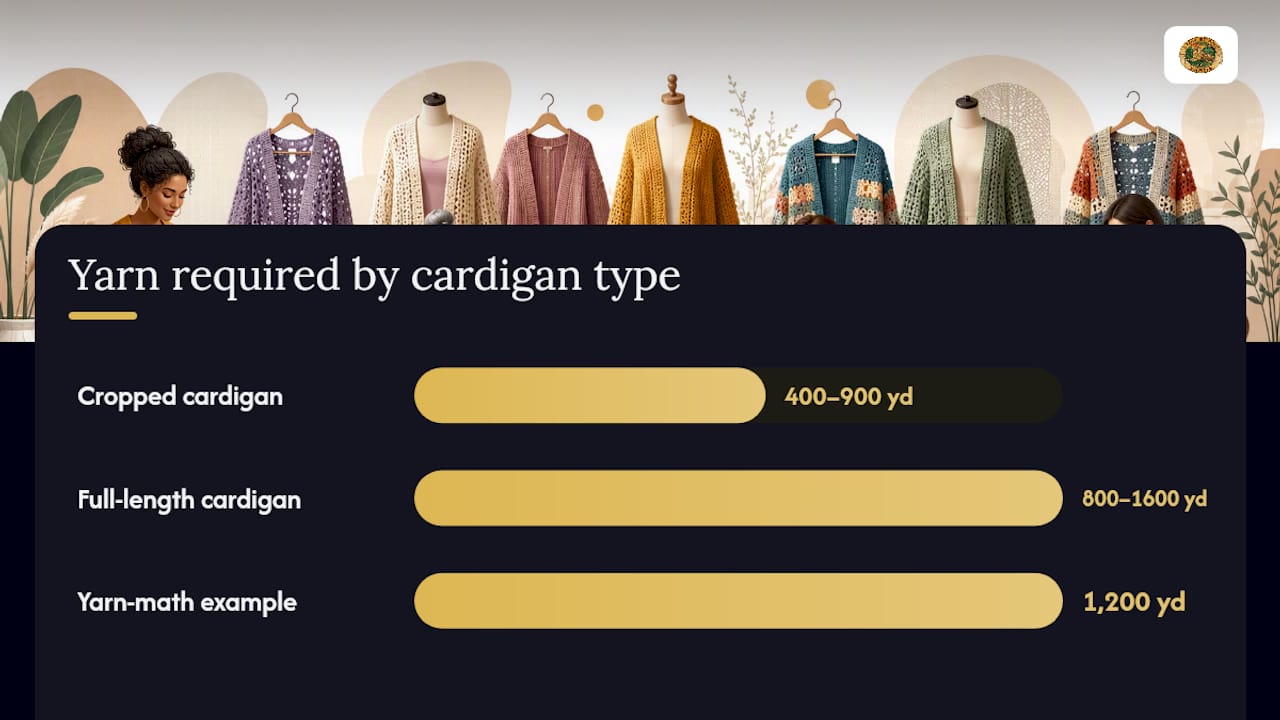
Yarn amounts swing widely with size, gauge, and yarn weight, so treat any number as a starting range rather than a guarantee. A cropped or lightweight cardigan typically requires a moderate amount of yarn, while a full-length worsted-weight adult cardigan requires more yarn.
For everyday washability, Wool-Ease Yarn holds shape wash after wash. For a lighter, drapier cardigan in warm weather, 24/7 Cotton Yarn breathes better against skin. For extra warmth without added bulk, Heartland Yarn gives a soft, rustic hand that still machine-washes.
Cropped/lightweight cardigan: 400 to 900 yards.
Full-length worsted cardigan: 800 to 1,600 yards.
Always buy one extra skein of the same dye lot until you finish blocking.
Yarn math check: a worsted cardigan needing 1,200 yards and a yarn that runs 197 yards per skein means budgeting about 7 skeins, not 5. Skimping here is the fastest way to end up ripping out rows to stretch yarn across the last sleeve.
What Stitch Is Best for a Crochet Cardigan?
Double crochet and half double crochet dominate free cardigan patterns because they build fabric fast and drape well on the body. Granny stitch and V-stitch work almost as quickly and add texture without slowing you down much. Save textured or lace stitches for a second or third cardigan, once you already trust your gauge.
Construction matters as much as stitch choice. Flat panels seamed at the shoulders and sides are the most forgiving option for a first garment, since designers commonly build cardigans from a back panel and two front panels with sleeves added later. Top-down, one-piece construction skips seaming almost entirely, which suits crocheters who dread sewing pieces together.
Fastest stitches: double crochet, half double crochet, granny/V-stitch.
Easiest construction: flat panels with simple seaming, or top-down one-piece.
Realistic time: a short-sleeve version finishes in about 8 to 15 hours, a fair benchmark for a weekend-style project.
How Do You Follow a Cardigan Pattern Without Ruining the Fit?
Crochet a gauge swatch first, at least 4 inches square, and measure it before casting on the real pattern pieces.
Compare your stitch count to the pattern’s gauge, then recalculate your target stitch counts if your gauge runs tighter or looser than listed. This is the same logic pattern designers use to grade one pattern into multiple sizes.
Measure each panel against your body (or a well-fitting cardigan) every few inches, not just at the end.
Pin sleeves in place before sewing, checking that both sides sit at the same height on the body.
Block the finished pieces with a light steam or wet-block, pinning edges flat, then let them dry completely before seaming.
Pro Tip: Check your gauge again after the first 4 to 6 rows, not just on the swatch. Tension often loosens once you relax into a project, and catching that early saves you from a cardigan that grows two sizes by the hem.
Where Can You Find Reliable Cardigan Patterns and Yarn Support?
Lion Brand’s free pattern library sorts crochet cardigans by skill level, so you can filter straight to beginner or adventurous-beginner projects instead of scrolling blind. Several patterns are available as ready-to-start picks, each written for a different comfort level with garment shaping.
Beginner and adventurous-beginner tags mark which patterns skip complex shaping.
Yarn pairings link directly to the weight and fiber each pattern calls for, from Vanna’s Choice Yarn for everyday acrylic to Feels Like Butta Yarn for a softer drape.
The company has a longstanding history of building yarn lines and pattern support for home crocheters, from heritage staples to newer machine-washable fibers.
Why Lion Brand Says Start Small on Your First Cardigan
A quick cardigan teaches shaping, seaming, and gauge in one project instead of three separate practice pieces. Finish one, and a bigger garment stops feeling out of reach. Lion Brand’s video tutorials and downloadable pattern PDFs shortcut the trickiest steps, from sleeve setting to blocking, so a first cardigan builds real skill instead of just filling a weekend.
Ready to Start? Grab a Pattern and the Yarn to Match
Three Lion Brand patterns cover most of what a first-time or returning cardigan-maker needs. The Ava Cardigan Pattern suits a crocheter ready for a classic fitted shape. The Mysa Cardigan Pattern works for anyone wanting a slightly different silhouette without jumping to advanced shaping. The Back to Basics – Crochet Cardigan strips construction down to its simplest form, built for a first garment.
If you’d rather have yarn and pattern bundled together, browse the knit and crochet kit collection for a curated match instead of guessing skein counts on your own. Pair any of these three patterns with Wool-Ease Yarn for durability or 24/7 Cotton Yarn for warm-weather drape, then check out and start your first row this weekend.
Sources
FAQ
What Crochet Stitch Is Best for a Cardigan?
Double crochet and half double crochet are the most common choices because they build fabric quickly and drape naturally on the body; granny stitch and V-stitch are close runners-up for texture without extra effort.
What Is the Easiest Cardigan to Crochet?
A rectangle-panel or one-piece top-down cardigan in worsted-weight yarn is generally the easiest, since it uses simple stitches and minimal seaming, similar to the flat-panel construction common in beginner-focused designs.
What Is the Easiest Crochet Sweater Pattern?
Patterns limited to chain, single crochet, and double crochet tend to be the easiest sweater-style projects for a first-timer.
How Many Skeins of Yarn Does It Take to Crochet a Cardigan?
Expect roughly 3 to 8 balls of worsted-weight yarn for an adult cardigan, depending on size, based on the yardage listed for the Northwoods Crochet Cardigan; cropped or lightweight versions need less, full-length or bulky-yarn versions need more.