Free Crochet Shawl Patterns for Every Skill Level
The fastest way into a new shawl project is a shortlist sorted by skill and shape, not a scroll through hundreds of options. Start with a beginner top-down triangle or a simple rectangular wrap, then match it to a worsted or fingering yarn depending on how much drape you want.
Beginner: top-down triangle, worsted weight, 5.5mm hook
Intermediate: crescent or tip-to-tip stripes, fingering to DK weight
Advanced: lace half-circle or asymmetrical, fingering weight
Key Takeaways
Free crochet shawl patterns work best when matched by skill level, shape, and yarn weight before you pick up a hook.
| Point | Details |
|---|---|
| Start with skill and shape | Match your experience level to a triangle, crescent, or rectangle pattern before picking yarn. |
| Worsted weight is forgiving | A 5.5mm hook with worsted-weight yarn suits most beginner shawl patterns. |
| Yardage scales with size | Plan for roughly 200 to 1,200+ yards depending on whether you’re making a scarf-sized or full shawl. |
| Construction changes the look | Top-down suits beginners; tip-to-tip creates vertical stripes ideal for self-striping yarns. |
| Lion Brand supports the whole project | Lion Brand’s free patterns pair directly with its yarn collections by weight and fiber. |
Table of Contents
Crochet Shawl Patterns Sorted by Skill Level and Shape
Choosing a pattern gets a lot easier once you stop browsing by “prettiest photo” and start filtering by skill and shape. Here’s a working shortlist across the three skill tiers, with one shape example in each.
Beginner picks:
Simple top-down triangle — Easy to check your gauge and size as you go; forgiving for first-timers. Worsted weight, 5.5mm hook. Free video tutorial available.
Repeatable one-row triangle — Patterns like the Lace Triangle Shawl use a short, meditative row repeat that’s easy to memorize and just as easy to set down mid-project.
Rectangular wrap — No shaping to track, just straight rows, which makes it the lowest-stress shawl on this list. Worsted or DK weight works well.
Intermediate picks:
Crescent shawl — Center increases create a curved shape that stays put on the shoulders without pins. DK or fingering weight, PDF pattern typically included.
Tip-to-tip triangle — Worked sideways, this construction shows off self-striping yarns like Mandala Yarn in bold color blocks.
Half-circle shawl — Combines short-row shaping with basic stitches; a solid bridge before tackling lace.
Advanced picks:
Asymmetrical lace shawl — One-sided increases plus a lace stitch chart demand more attention to your row count, but the payoff is a dramatic drape.
Circular shawl with filet sections — Combines chart-reading with garment-level finishing techniques like blocking wires.
To size any of these up or down, add or subtract full pattern repeats rather than partial ones, and adjust your hook by half a millimeter if the fabric feels stiff or floppy compared to the photo.
Pro Tip: Before starting, check whether the pattern lists a printable PDF or a companion video. Written patterns without video support are fine for confident readers, but if you’ve never tried a specific construction before, a video walkthrough saves hours of frogging.
What Are the Different Crochet Shawl Shapes?
Shape decides how a shawl behaves once it’s off the hook, which matters more than most people expect before they’ve worn one.
Triangle — The most common shape and the easiest to modify; wraps around shoulders and drapes into a V in front.
Crescent — Curved bottom edge that hugs the neckline and resists slipping off, ideal for wearing all day.
Half-circle — A fuller version of the crescent with more fabric at center back for extra warmth.
Rectangle/wrap — The most versatile shape; fold it, drape it, or wear it as a scarf.
Circular — Worn like a poncho or folded over one shoulder; showcases lace repeats beautifully.
Asymmetrical — Longer on one side, great for scrap yarn or dramatic styling.
Pro Tip: Self-striping and gradient yarns like Mandala Ombre Yarn look best in tip-to-tip or bottom-up triangles, where the stripes run horizontally and the color shifts read clearly.
How Do You Crochet a Triangle Shawl?
Triangle shawls come in four basic builds, and picking the right one depends on what you want the finished fabric to look like.
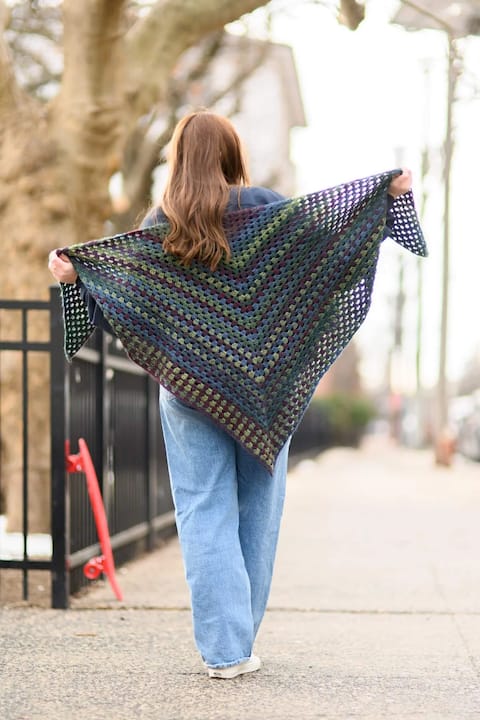
Top-down starts at the neck with a small foundation (often a magic ring or a chain-4 ring joined into a circle), then grows outward row by row. It’s the easiest to try on as you go, which is why most beginner triangle patterns use it.
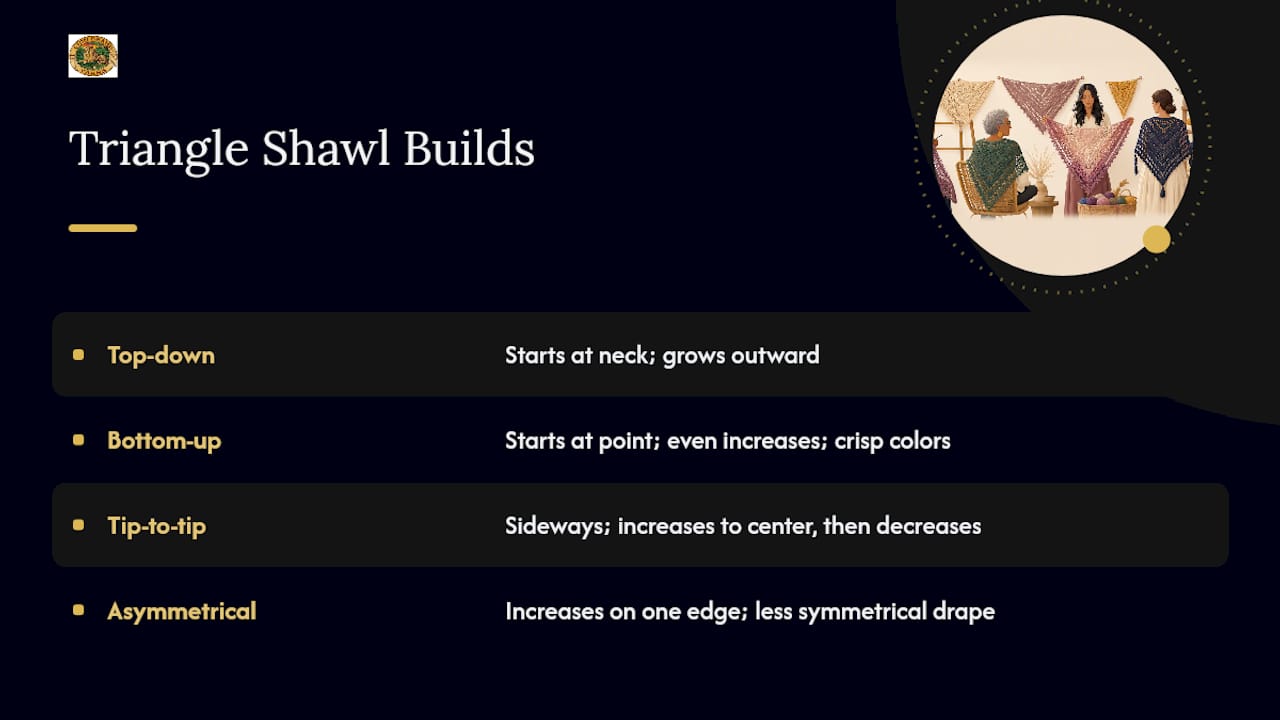
Bottom-up starts at the point and increases evenly across each row, making horizontal color changes especially crisp.
Tip-to-tip (also called side-to-side) is worked sideways from one point, increasing to the center, then decreasing to the opposite point. This construction creates strong vertical stripes and pairs beautifully with self-striping skeins.
Asymmetrical triangles increase on only one edge, which is an easy tweak to make to almost any standard triangle pattern if you want a less symmetrical drape.
Yarn Weight, Hook Size, and Yardage for Shawls
Yarn weight runs from lace (#0) up through jumbo (#7), and shawls can be made in nearly any of them, though fingering, DK, and worsted (#4) show up most often in free patterns. For a first shawl, worsted weight with a 5.5mm hook is about as forgiving as it gets.
Small (neck scarf size): roughly 200 to 400 yards
Medium (everyday wrap): roughly 400 to 700 yards
Large (full shawl): roughly 700 to 1,200 yards or more
Pro Tip: If you swap to a lighter yarn weight, size up your hook slightly for drape and expect to need more yarn to cover the same area. Yarn base and fiber content also change how a shawl hangs, so swatch a few rows before committing to a full skein order.
Beginner Tips for Reading Patterns and Finishing a Shawl
Most free patterns open with a skill label, a stitch list with abbreviations (sc, hdc, dc, sk, rep), yardage, gauge, and finishing notes. Read all of that before your first stitch.
Common shawl stitches include double crochet for open, fast fabric; half double crochet for a denser middle ground; shell stitches for texture; and V-stitches for lacy, breathable panels. Swatch a few rows in any unfamiliar stitch before starting the real project.
Block finished shawls with pins or wires to open up lace and even out edges.
Add a simple single-crochet or picot border to clean up raw edges.
Weave in ends along stitch posts, not across open lace, so they stay hidden.
Pro Tip: Wet-block lace shawls rather than steaming them. Steam can flatten texture, while a full soak and pin-out lets the fibers relax into shape permanently.
How Do I Choose the Right Shawl Pattern?
Run through these steps in order, and you’ll land on a pattern you’ll actually finish.
Match the pattern’s skill label to your actual experience, not your aspiration.
Pick a shape based on how you’ll wear it (crescent for staying put, rectangle for versatility).
Confirm you can get the recommended yarn weight and fiber, or pick a suitable substitute.
Check the yardage against what you own or plan to buy.
Consider your timeline. Simple repeat stitches finish faster than lace charts.
Confirm whether a PDF or video tutorial is available if you’re new to the construction.
Why Shawls Make a Great Next Crochet Project
Shawls reward makers at every stage because the sizing is flexible. Run short on yarn or time, and you simply stop a few rows early with no ruined garment. Simple repeat stitches build the muscle memory for tension control, while lace charts teach pattern reading in a low-stakes format since a dropped stitch rarely ruins the whole piece. Lion Brand’s pattern library and yarn range give makers a steady supply of both.
Lion Brand Picks to Match Your Next Shawl
Once you’ve picked a shape and skill level, matching yarn and pattern shouldn’t take another hour of searching. Lion Brand’s Elle Shawl pattern pairs a straightforward triangle build with a yarn recommendation already built in, so there’s no guesswork on weight or yardage.
For makers who want something with a bit more texture, the Jools Shawl works up in a worsted weight that’s easy to swatch and block, and the Perry Street Shawl offers a named, shop-ready design for crafters ready to move past a first project. Pair any of these with Wool-Ease Yarn for warmth and stitch definition, or 24/7 Cotton Yarn if you’re planning a lightweight summer wrap. Browse the full yarn collection to match fiber and weight to whichever pattern you’ve chosen, then head to the pattern page to download and start your next shawl today.
Sources
FAQ
What is the best crochet stitch for a shawl?
Double crochet and half double crochet are the most common choices because they work up quickly and create even, flexible fabric that drapes well.
What are some good crochet shawl patterns for beginners?
A top-down triangle or a repeatable one-row pattern are both solid starting points since they use simple, repeating stitches.
What are the basic shawl shapes?
The main shapes are triangle, crescent, half-circle, rectangle/wrap, circular, and asymmetrical, each affecting how the finished piece drapes and stays on the shoulders.
How much yarn do I need to make a crochet shawl?
Small shawls typically use 200 to 400 yards, medium wraps use 400 to 700 yards, and large shawls can run 700 to 1,200 yards or more depending on yarn weight and pattern.