Free Crochet Blanket Patterns for Every Skill Level
Image: Crochet Mood Blanket 2026
Free crochet blanket patterns worth your time live in two places: curated pattern roundups across the web and Lion Brand’s free pattern library, which sorts everything by skill level and project size. If you’re picking a first project, start with a double-crochet baby blanket, a classic granny-square throw, or a ripple/chevron throw. All three forgive uneven tension while you learn.
Double-crochet baby blanket: a stitch easy to learn that works up quickly
Granny-square throw: works in small, portable pieces you join later
Ripple/chevron throw: modest yardage plus a payoff quality look
Grab a worsted weight #4 acrylic yarn and a 6.0mm hook, and you can cast on tonight. The Craft Yarn Council’s standard weight system makes substituting yarn painless, and a plain 45×60 inch throw typically runs 1,000 to 1,600 yards in #4 weight, so you can shop with confidence instead of guessing.
Key Takeaways
Free, high-quality crochet blanket patterns are widely available, and a double-crochet baby blanket in washable worsted yarn is the fastest route to a finished project.
| Point | Details |
|---|---|
| Start with double crochet | It works up roughly twice as fast as single crochet, making it the best beginner stitch for blankets. |
| Buy yarn by size, not guesswork | Baby blankets need 500 to 700 yards, throws need 1,200 to 1,600 yards, in worsted #4 weight. |
| Swatch before you scale up | Wash and weigh a gauge swatch to calculate exact yardage before buying full quantities. |
| Finish with a simple border | A single-crochet border with three stitches in each corner keeps edges square and polished. |
| Start with Lion Brand’s patterns | The Crochet Diagonal Pattern Baby Blanket matches beginner-friendly yarn and hook guidance. |
Table of Contents
Crochet Blanket Patterns Sorted by Skill Level and Style
Not every blanket pattern deserves your first skein. Some eat yarn without much payoff; others teach you a stitch you’ll use for years. Here’s how the major categories stack up.
Beginner patterns lean on one or two stitches repeated for rows. A double-crochet baby blanket in a single color, or with simple color-blocked stripes, is the easiest entry point because double crochet is roughly twice the stitch height of single crochet, which means blankets work up noticeably faster. The Crolla Baby Blankie and the Sweet Baby Blankie both use this logic: simple stitches, satisfying color changes, finished in a weekend or two with worsted weight yarn.
Classic granny-square throws solve a real problem: big blankets feel unmanageable when you’re new. Squares break the project into bite-sized pieces you can finish on a lunch break, then join with slip stitch or a simple whip-stitch seam. The Three Color Baby Granny Blankie is a strong choice here, and it’s also the best format for scrap yarn, since each square only needs small amounts.
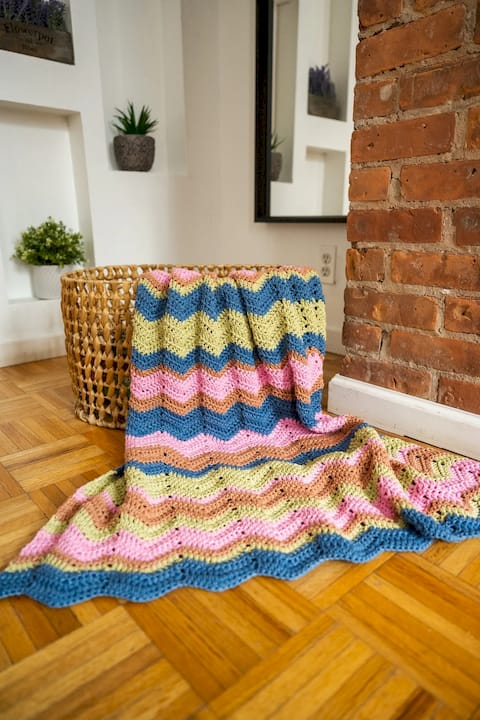
Ripple and chevron blankets trade a little more counting for a lot more visual payoff. The zigzag comes from paired increases and decreases across each row, and once you memorize the repeat, the pattern practically crochets itself. The Striped Ripple Afghan shows how a handful of bright colors turns a basic ripple into something that looks far more complicated than it is.
Temperature blankets and scrapghans are less a pattern than a system. You crochet one row (or one square) per day based on the day’s high temperature, or you simply use up leftover yarn in whatever stitch you’re currently comfortable with. Neither requires a special skill, just consistency and a stash. This is where odd half-skeins from other projects finally earn their keep.
Textured stitch sampler blankets suit crocheters who already have a few finished projects behind them. Waffle stitch, basketweave, and moss stitch all add visual depth but slow your pace considerably, since they typically involve working into stitches from a row or two back rather than straight into the next stitch.
For yarn, washable worsted acrylic is the default recommendation across nearly every free pattern roundup, because it holds up to spills and machine washing without the finished blanket losing its shape. Vanna’s Choice and Wool-Ease both fit that brief, and self-striping options like Mandala let you build stripes into ripple or striped baby blanket patterns without changing skeins mid-row.
Pro Tip: If you’re between two patterns and one uses a stitch you’ve never tried, crochet a 6-inch swatch first. It takes ten minutes and saves you from frogging three hours of work over a tension problem you could have caught early.
How to Crochet a Baby Blanket Start to Finish
This double-crochet baby blanket is the pattern most free crochet roundups point beginners toward first, and for good reason: one stitch, one repeat, done.
What you need:
Worsted weight #4 acrylic yarn, about 500 to 700 yards for a standard baby blanket size
6.0mm (J) crochet hook
Yarn needle for weaving in ends
Stitch markers (optional but helpful)
Instructions:
Chain a multiple of any number, plus 2 for the turning chain. For a 30 inch wide blanket in worsted weight, that’s roughly 90 to 96 chains, adjusted to your gauge.
Row 1: double crochet in the third chain from the hook, then double crochet in every chain across. Turn.
Row 2: chain 2 (this counts as your first double crochet), double crochet in every stitch across, ending in the top of the turning chain from the previous row. Turn.
Repeat Row 2 until your blanket measures the length you want, typically 36 to 40 inches for a baby blanket.
Fasten off, leaving a 6 inch tail, and weave in all ends with your yarn needle.
Beginners usually run into two problems on this pattern: the blanket slowly narrows, or it slowly widens. Both come from missing or adding a stitch at the edges, usually because the turning chain gets skipped or double-counted. Count your stitches every few rows until it becomes automatic, and place a stitch marker in the very first stitch of each row if you keep losing track.
Expect this pattern to use close to the full 500 to 700 yard range recommended for baby-sized blankets in #4 yarn, though gauge and hook size will shift that number slightly in either direction.
Yarn, Hook Size, and Yardage by Blanket Size
Buying yarn without a yardage plan is how half-finished blankets happen. Here’s what to buy based on the size you’re making.
Worsted weight #4 acrylic or acrylic-blend yarn is the right starting point for almost any first blanket. It’s inexpensive, machine washable, and forgiving of inconsistent tension while you’re still learning. A 6.0 to 6.5mm hook, which usually runs one size larger than the label recommends, gives the finished fabric a looser, more drapable hand instead of stiff, board-like stitches.
| Blanket size | Yarn needed (approx.) | Suggested hook |
|---|---|---|
| Baby blanket | 500–700 yards | 6.0 to 6.5mm |
| Lapghan | 1,000 yards | 6.0mm |
| Throw (45×60 in.) | 1,200–1,600 yards | 6.0–6.5mm |
| Twin | 1,000 to 1,600 yards | 6.0–6.5mm |
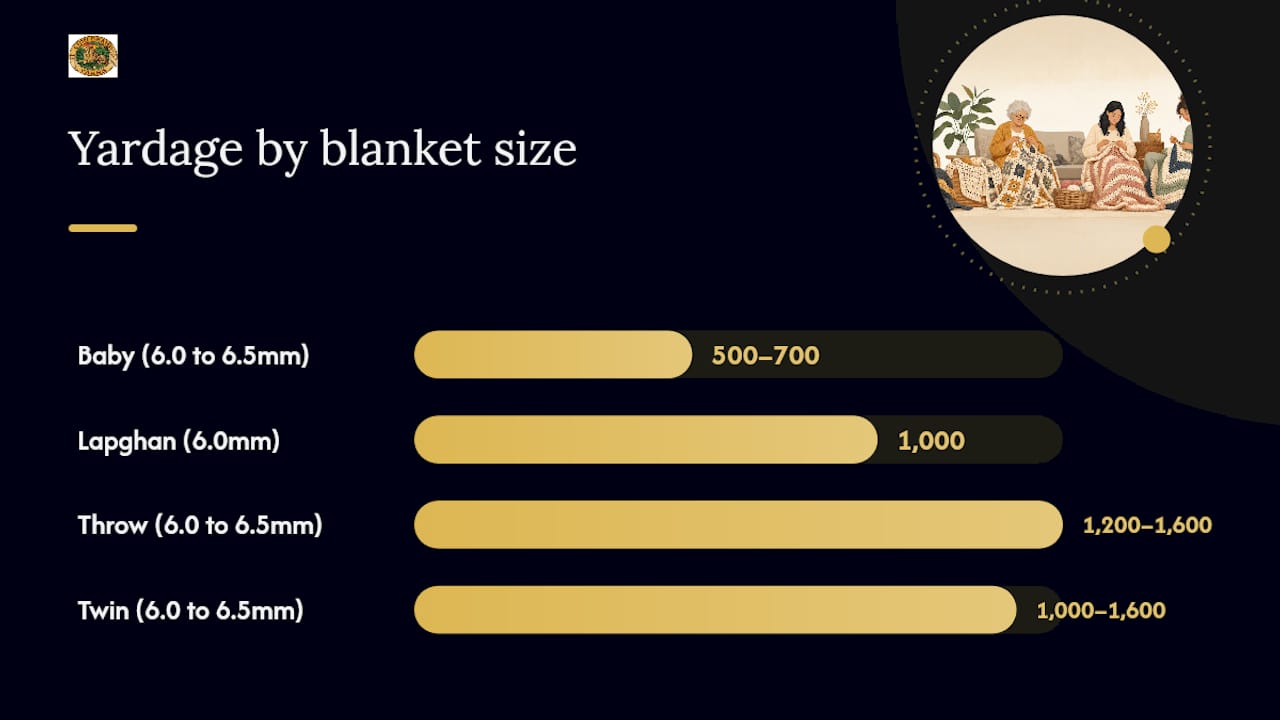
These ranges come from standard #4 weight recommendations for beginner blankets and confirmed by yardage estimates for full-size afghans, but stitch choice and gauge both push the numbers around.
The smartest way to nail down your exact number is to crochet and wash a small swatch first, then weigh it and calculate yardage per square inch before you scale up. It sounds fussy, but it beats running out of yarn two-thirds through a blanket and hunting for a dye-lot match.
Fiber choice matters as much as weight. Acrylic is the easy-care workhorse for everyday blankets that get washed often. Cotton breathes better but gets heavy fast in a dense stitch, so it suits lighter, more open patterns. Bulky yarns work up in a fraction of the time but flatten out stitch definition, which matters if you’ve picked a pattern for its texture.
Which Crochet Stitches Work Best for Blankets?
Stitch choice decides how fast you finish and how the blanket feels once it’s done.
Double crochet: the default “work-up-fast” stitch, roughly twice the height of single crochet, which means fewer rows for the same size blanket
Half double crochet: a denser, warmer fabric than double crochet, good for cold-climate throws
Treble crochet: the fastest stitch by row count, though it produces a looser, more open fabric
Granny squares: modular, portable, and ideal for scrap yarn since each motif uses very little
Waffle stitch: cozy and textured, but slower and yarn-hungry compared to plain double crochet
Tunisian crochet: structured, almost knit-like fabric, best saved for crocheters comfortable managing many loops on the hook
Speed and warmth pull in opposite directions most of the time. Treble crochet finishes fastest but leaves gaps that let heat escape; half double crochet is slower to work but blocks drafts better.
Pro Tip: Save the heavily textured stitches for your second or third blanket. They’re gorgeous, but on a first large project the combination of new stitch, unfamiliar tension, and a big yardage commitment is a recipe for frustration.
Finishing Touches: Borders, Blocking, and Care
A simple single-crochet border, worked evenly around the whole blanket with three single crochet stitches in each corner to keep it square, instantly makes a homemade blanket look intentional rather than unfinished.
Blocking depends on fiber. Natural fibers like wool or cotton benefit from wet blocking, where you soak the finished piece and pin it to size while it dries. Acrylic doesn’t hold a wet block the same way, but a gentle reshape and flat-dry after washing still evens out curled edges.
| Fiber | Wash method | Dry method |
|---|---|---|
| Acrylic | Machine wash, gentle cycle | Dry flat |
| Cotton | Hand wash or gentle machine cycle | Dry flat |
| Wool blends | Hand wash | Dry flat, reshape while damp |
For any heavy, saturated blanket, lift it out of the wash water using a bed sheet as a sling rather than pulling it out by hand. Wet yarn is heavier than it looks, and lifting a soaked blanket by one edge is a fast way to stretch it permanently out of shape. Once the border is done, double-check that every end is woven in securely. Loose tails are the first thing to unravel with repeated washing.
Fixing Common Crochet Blanket Mistakes
Big projects mean small mistakes compound fast if you don’t catch them early.
Edges growing or shrinking: almost always a turning-chain issue; count stitches every few rows and place a marker in the first stitch of each row
Wavy or rippled edges: usually a tension shift partway through; blocking often fixes mild waviness, but consistent tension prevents it
Missed or extra stitches: count in sections of ten rather than the whole row, so you find the gap faster
Small holes or gaps: a single missed stitch a few rows back can often be left alone if it’s not near an edge; anything larger should be frogged back and reworked
If the mistake is within the last few rows, unraveling (“frogging”) back to it and reworking is faster than you’d think. If it’s buried twenty rows down and barely visible, it’s often not worth the unraveling.
Pro Tip: Take a short break every 30 to 40 minutes on a long blanket project. Tension creeps tighter as your hand tires, which is exactly what causes those subtle waves along one edge.
Lion Brand’s Pattern Library and Recommended Yarns
Lion Brand’s free pattern library lets you filter by skill level and project size, so you can go straight to patterns matched to where you actually are as a crocheter.
Radiant Waves Throw: let color-changing yarn amp up a classic ripple pattern
Myrtle Baby Blanket: a step up from a plain stripe, using stitches of different heights to create visual interest
Arwynn Blanket: a classic color combo will sing in this color-blocked design
For yarn, Wool-Ease and 24/7 Cotton both offer easy-care options suited to the beginner-friendly patterns above.
Sizing a Blanket Beyond the Standard Chart
Standard sizes are a starting point, not a rule. A baby blanket doesn’t have to stop at 36 inches if the recipient’s crib needs more coverage, and a “throw” can be stretched into something closer to a twin-bed topper with a few extra pattern repeats.
The math is simpler than it looks. Most blanket patterns are built on a stitch repeat, meaning a specific number of stitches that creates one unit of the pattern (a ripple point, a granny motif, a stripe sequence). To make a blanket wider, add chains in multiples of that repeat, not just any number, or the pattern will break partway across the row. To make it longer, simply work more rows.
Yardage scales roughly in proportion to area. This is exactly where a washed gauge swatch pays off. Weigh it, calculate the yarn used per square inch, then multiply out to your new custom dimensions instead of guessing and hoping your third skein arrives in the same dye lot.
Odd sizes also solve real problems: a lapghan sized for a wheelchair, a extra-long throw for a tall recipient, or a square baby blanket instead of a rectangle for easier stroller use. None of these require a different pattern, just adjusted starting chains and a little arithmetic before you cast on.
Choosing Colors and Yarn for the Blanket Style You Want
Color and fiber decisions shape a blanket’s personality as much as stitch choice does.
For a nursery blanket, soft pastels or gender-neutral tones in a washable acrylic like Vanna’s Choice hold up to frequent washing without pilling or fading fast. A self-striping yarn like Mandala does the color planning for you, producing gradual stripe transitions in a single skein instead of requiring you to track multiple color changes by hand.
For a farmhouse or cabin-style throw, consider a heathered or tonal worsted yarn in cream, rust, or forest green. These colors hide small tension inconsistencies far better than a bright solid does, which matters if you’re still building confidence with even stitches.
Bold graphic blankets, the kind built from high-contrast color blocks or stripes, work best in solid, saturated colors rather than variegated or self-striping yarns, since a busy background yarn will fight with an already busy stitch pattern.
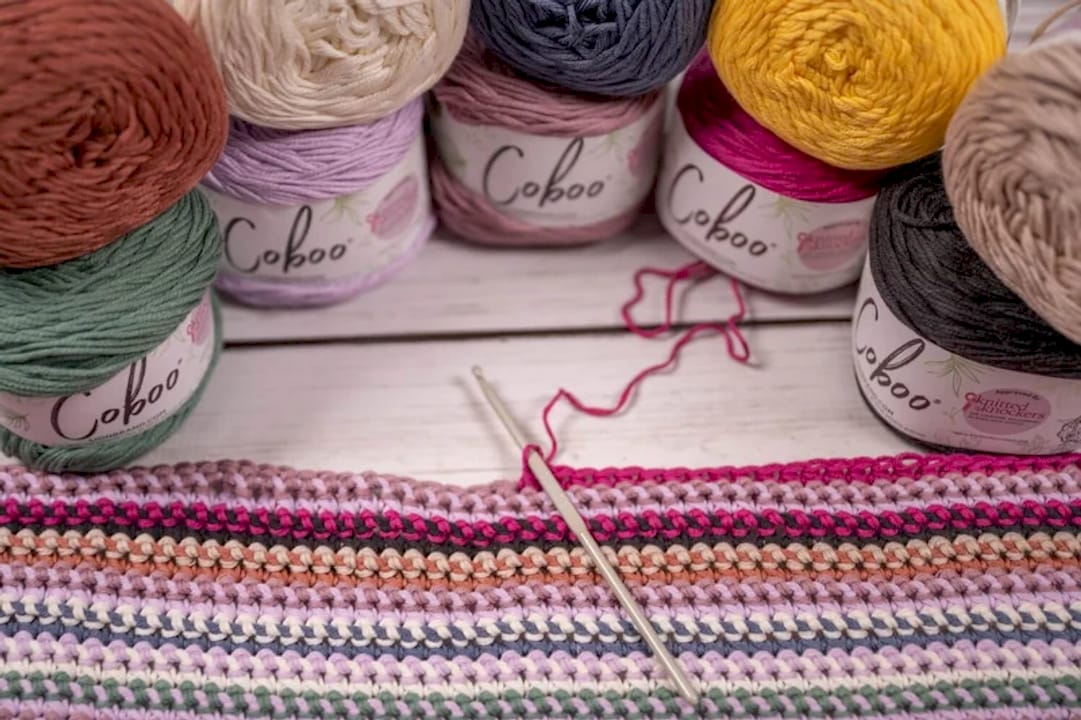
Fiber affects the feel as much as the look. A cotton blend like Coboo gives a lightweight, breathable drape suited to summer throws or lighter nursery blankets, while a plush option like Feels Like Butta leans into cozy, heavier blankets meant for couch time in winter. Neither is more “correct” than the other. It comes down to when and where the blanket will actually get used.
Personalizing Your Blanket With Motifs and Variations
Once you’ve made one or two blankets from a straightforward pattern, small variations turn a standard project into something that feels custom without starting from scratch.
Swapping a plain granny square for a sunburst or flower granny variation changes the entire look of a scrapghan while keeping the same modular, join-as-you-go construction. Adding a contrasting border color, even a single round of a bold accent yarn around an otherwise neutral blanket, gives a simple pattern a finished, boutique look.
Combining motifs is another easy customization: alternate solid granny squares with striped or textured ones across the same blanket for visual rhythm without learning an entirely new stitch. For a baby blanket, working an initial or a simple shape into the corner using a basic color-block technique personalizes a gift without adding real difficulty.
Ripple and chevron patterns take well to color experimentation, since changing where color transitions land along the zigzag can create entirely different visual effects from the same basic stitch repeat. A temperature blanket is, at its core, just this idea taken to its logical extreme: one pattern, personalized entirely through color choices made row by row over the course of a year.
Why Blankets Are Great Projects for Any Skill Level
Blankets teach through repetition. Working double crochet across dozens of rows builds muscle memory faster than shorter projects ever could, and progress is visible almost immediately. Start small, a baby blanket or lapghan, with washable yarn and a comfortable hook, and confidence follows naturally.
Ready-Made Kits for Your Next Blanket
Skip the yarn math entirely: Lion Brand’s crochet kits come with pre-selected yarn in the exact yardage a pattern needs, so there’s no swatching, weighing, or guessing involved before you start
Sources
How to Crochet a Blanket for Beginners: Your First Cozy Project – Crochet Insider
What to Look for in Crochet Yarn for Afghans | The Hobby Guru
FAQ
What is the best crochet stitch for a blanket?
Double crochet is the most commonly recommended stitch because its taller height means fewer rows and faster progress than single crochet, while still being simple enough for beginners.
What is the fastest crochet pattern for a blanket?
A plain double-crochet blanket worked in one color, or with simple straight stripes, finishes fastest since there’s no shaping, color-work planning, or complex repeat to slow you down.
What is the coziest crochet stitch?
Half double crochet and textured stitches like waffle stitch trap more air and produce a denser, warmer fabric than open stitches like treble crochet, though they take longer to work.
What hook size should I use for a soft, drapey blanket?
Go up one hook size from what the yarn label suggests, typically 6.0 to 6.5mm for worsted weight #4 yarn, which loosens the fabric and improves drape.
How much yarn do I need for a throw blanket?
A standard 45×60 inch throw generally needs 1,200 to 1,600 yards of worsted weight #4 yarn, though textured stitches can push that number higher.